
MONUMENT LASER SERVICES
MONUMENT LASER SERVICES in Elizabethtown, KY.
Laser etching works by fracturing the polished surface of granite rather than cutting into it, which is why it reproduces photographic detail that no chisel can reach and why it needs dark, polished stone to give that detail contrast. Eternity Memorials, Inc. runs monument laser services across Central Kentucky, etching portraits, scenes, signatures, and emblems onto memorials, always working from your own photographs and always with the artwork approved by you before the machine ever starts. We are licensed and insured.
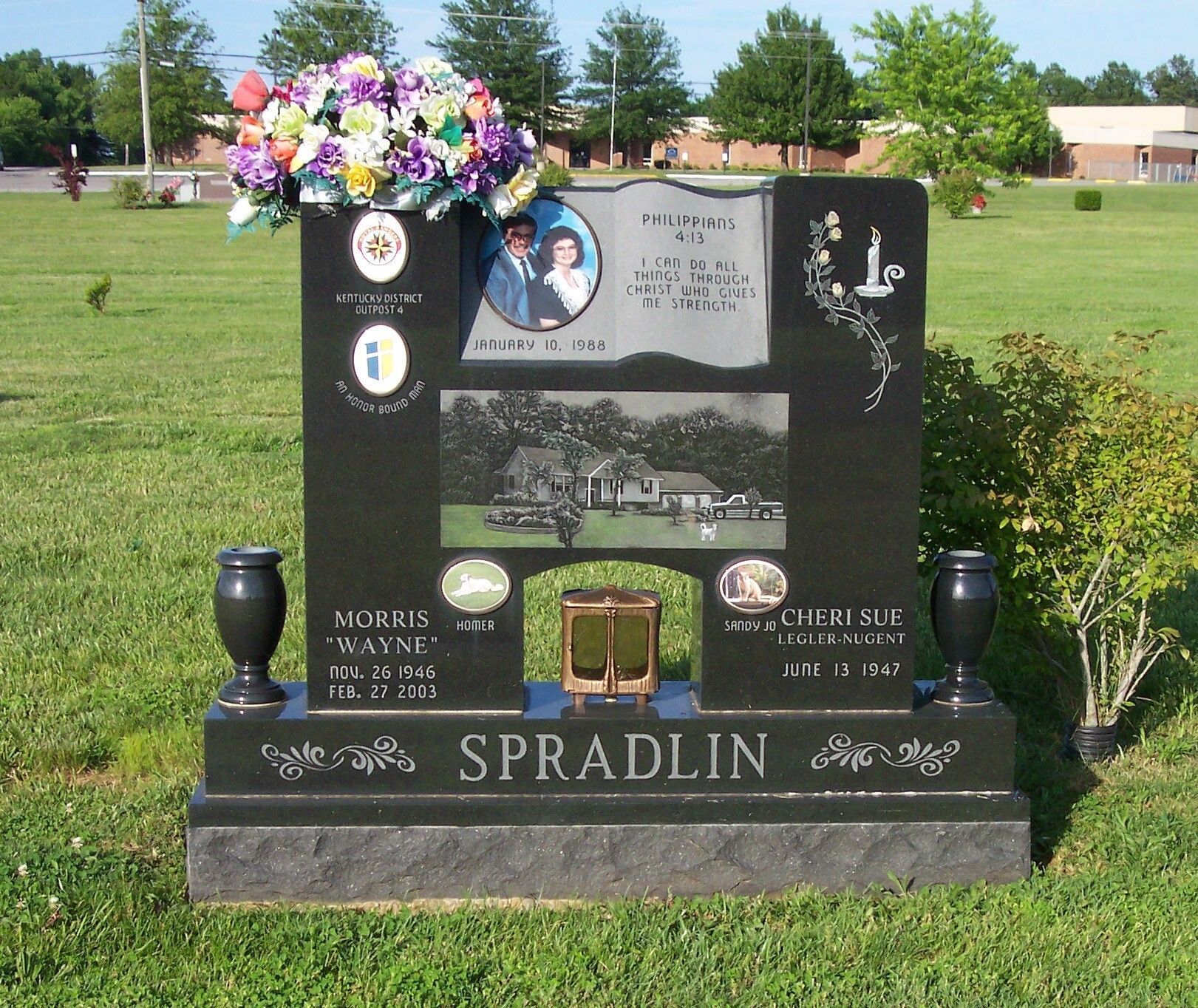
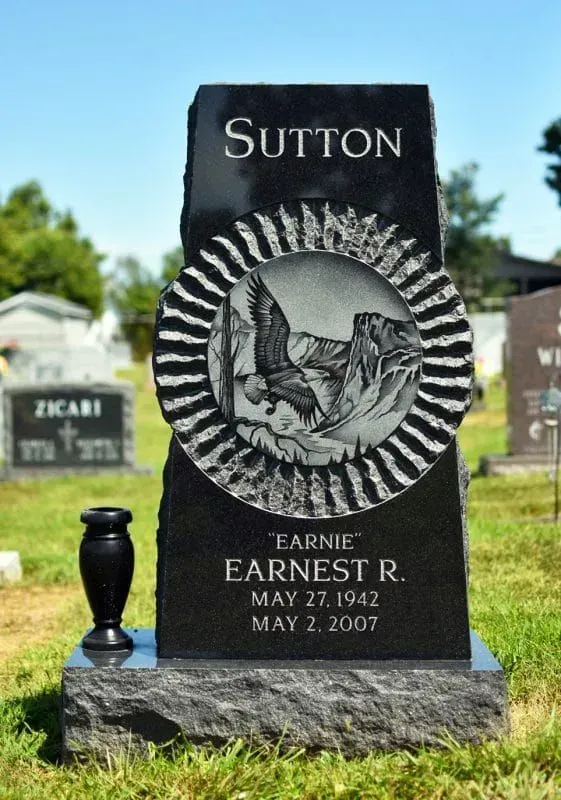
A PORTRAIT CHANGES WHO A STONE IS FOR.
Names and dates identify a person. A face makes strangers stop walking. That is the practical difference laser etching makes to a memorial, and it is why families who see a well-etched portrait in a cemetery so often come looking for the shop that produced it.
The quality of the result depends almost entirely on the photograph you bring us. A laser reproduces detail with remarkable fidelity, but it cannot invent detail that was never present in the original image to begin with, which is why we look at every picture before promising anything.
- Dark polished granite selected for maximum contrast
- Artwork proofed and approved before etching begins
- Portraits, scenes, signatures, and emblems reproduced
- Etching added to memorials already set in the cemetery
Lorem ipsum dolor sit amet, consectetur adipiscing elit. Sed do eiusmod tempor incididunt ut labore et dolore magna aliqua. Ut enim ad minim veniam, quis nostrud exercitation ullamco laboris nisi ut aliquip ex ea commodo consequat.
Insert Title
MONUMENT LASER SERVICES
THE STONE CAN CARRY MORE THAN A NAME NOW.
For most of this trade's history, a memorial could hold lettering and a carved emblem, and that was the practical limit. Laser etching removed it. A farm the family worked, a fishing boat, a church building, a handwritten signature from a letter, a wedding photograph, a beloved dog: any of these can now sit permanently on granite at photographic quality. Families who assumed a headstone had to be generic discover otherwise, sometimes with real emotion.
CENTRAL KENTUCKY SUBJECTS COME UP AGAIN AND AGAIN.
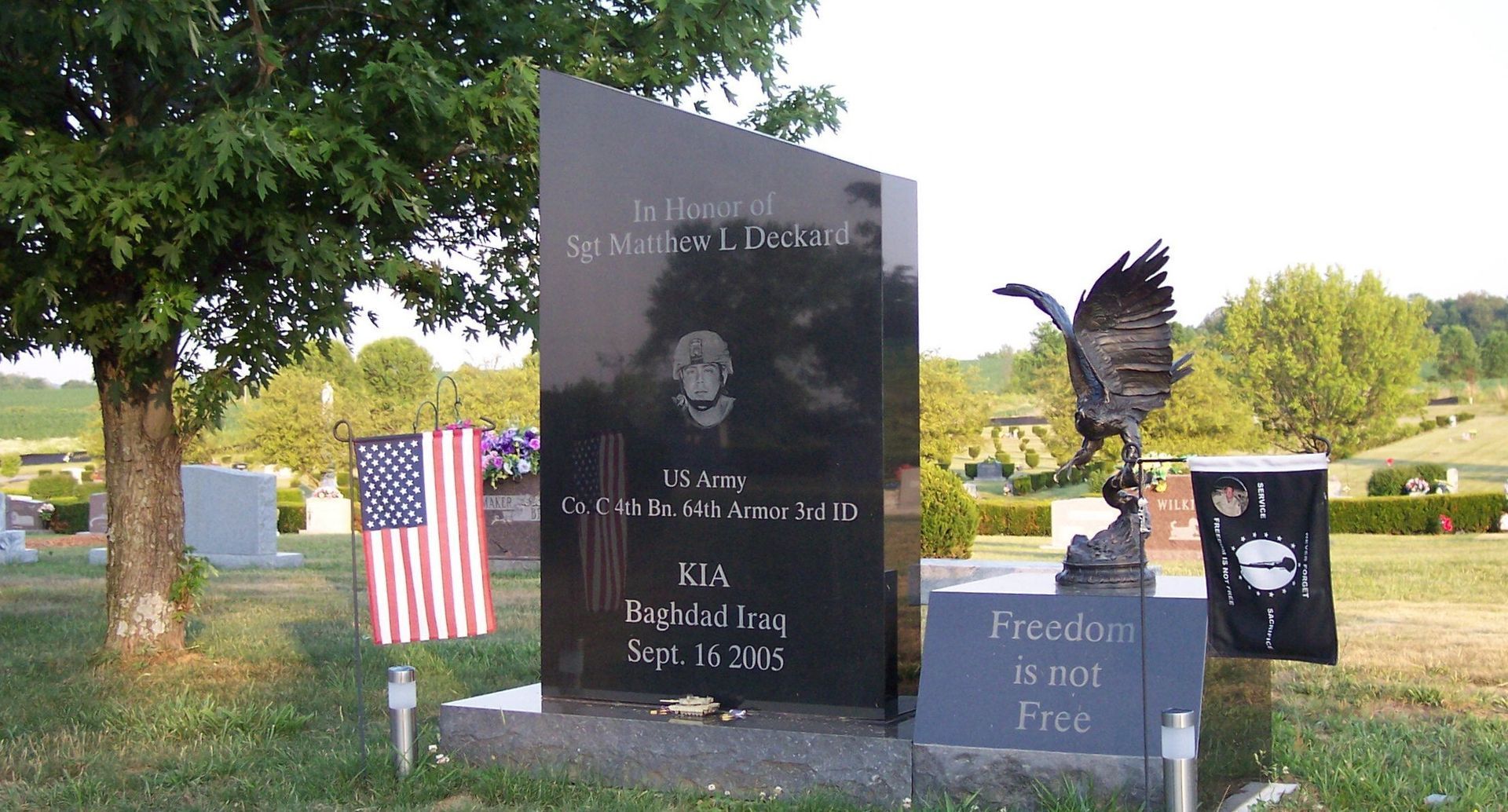
Certain images recur in this part of the state, and we have etched a great many of them: tobacco barns, tractors, deer, bass boats, church steeples, Fort Knox service emblems, and family homeplaces photographed decades ago. Familiarity with those subjects matters, because knowing how a barn roofline or a uniform insignia should read in etched grayscale is the difference between a recognizable image and an approximate one.
SCRAP GRANITE TAUGHT US THE LASER, NOT A BROCHURE.
When this technology arrived, nobody could tell us how a photograph would behave on a given stone, so we found out on offcuts, the way we have solved most new problems across 35 years. Many test panels later, we can look at an image and tell you honestly whether it will etch well, whether it needs work first, or whether another photograph would serve better. Have you found the picture you actually want on the stone?
WHAT LASER ETCHING GIVES A MEMORIAL
A FACE PEOPLE RECOGNIZE
A portrait turns a marker into a person. Visitors who never met them still get a sense of who is buried there, which lettering alone cannot achieve.
DETAIL BEYOND CARVING
Fine gradients, hair, foliage, brickwork, and fabric all reproduce at a level of detail that sandblasting and hand carving simply cannot deliver on any stone.
A HANDWRITTEN SIGNATURE
An actual signature taken from a card or letter, etched at full size, carries a startling amount of the person. Families frequently find this the most affecting element.
SUBJECTS THAT MEAN SOMETHING
Homeplaces, farms, workplaces, boats, and animals record what a life was actually spent on, rather than defaulting to a symbol chosen from a standard catalog.
PRECISE, REPEATABLE OUTPUT
Digital artwork means the etching that reaches the stone is exactly the artwork you approved, without variation introduced between the proof and the finished piece.
ADDITIONS TO EXISTING STONES
An etching can be applied to a memorial already standing in the cemetery, so families who wish they had asked for one are not out of options.
Insert Title
Lorem ipsum dolor sit amet, consectetur adipiscing elit. Sed do eiusmod tempor incididunt ut labore et dolore magna aliqua. Ut enim ad minim veniam, quis nostrud exercitation ullamco laboris nisi ut aliquip ex ea commodo consequat.
Insert Title
Common Questions
FREQUENTLY ASKED QUESTIONS.
Laser etching is recent enough that most families have no reference for what is possible or what it requires. These are the questions we answer across the counter most often.
What exactly is laser etching on a monument?
Laser etching uses a focused beam to fracture the polished surface of granite in a controlled pattern, creating light marks against a dark background. The finished result reproduces photographic images at a level of detail that carving simply cannot match.
Why does laser etching need dark granite?
Contrast. The etched marks appear light, so they only read clearly against a dark polished background such as black, charcoal, or deep gray granite. On light-colored stone the image loses its definition quickly and ends up looking washed out.
What photograph quality is needed for a laser portrait?
The sharpest original you can find, ideally a clear print or a high-resolution digital file. A laser reproduces exactly what is present in the image, so any softness, blur, or low resolution transfers directly into the finished etching.
How is laser etching different from sandblasting?
Sandblasting physically carves into stone through a stencil, cutting deep and working on any granite color at all, which suits bold lettering. Laser etching stays shallow at the surface instead, and excels at photographic detail on dark polished faces.
Does a laser-etched portrait fade over time?
The etching is a permanent physical change to the stone surface rather than a coating, so it does not fade or peel. Its shallow depth does make it noticeably more vulnerable to abrasive cleaning than deeply sandblasted lettering is.
Can etching be added to a monument already installed?
Yes, in a great many cases. The work happens at the gravesite itself and depends on the stone's color, finish, condition, and the weather. Eternity Memorials, Inc. assesses existing memorials for this across Elizabethtown, KY before committing to anything.
What subjects work best as a laser etching?
Images with strong contrast and clear edges reproduce best: faces in good light, buildings, vehicles, and animals. Eternity Memorials, Inc. reviews every photograph brought into Elizabethtown, KY, since busy backgrounds need editing before they will etch well on stone.
How deep does a laser etch into granite?
Only a fraction of a millimeter deep. It fractures the polished surface rather than removing material the way sandblasting does, and that is exactly why it can hold onto the photographic detail a deeper method would lose entirely.
HOW WE WORK
FROM PHOTOGRAPH TO ETCHED STONE, HERE IS HOW.
STEP 01
WE LOOK AT YOUR PHOTOGRAPH
Bring in everything you have, including the ones you assume are unsuitable. We assess sharpness, contrast, resolution, and background on each of them, and tell you honestly which image will make the best memorial.
STEP 02
WE CHOOSE THE STONE
Etching needs a dark polished surface to read properly at all. Granite color, finish, and the size of the panel available all get settled first, before any artwork preparation work begins on the image itself.
STEP 03
WE PREPARE THE ARTWORK
Backgrounds are removed or simplified, contrast is adjusted, and the image is converted for etching. Damaged, torn, or badly faded originals can often be restored digitally first, before they ever reach the machine.
STEP 04
YOU APPROVE THE PROOF
You see the prepared artwork at its final size, positioned on a scaled drawing of the monument. Nothing at all is etched until you have looked at it properly and confirmed that you are happy.
STEP 05
WE ETCH THE STONE
The prepared file is run on the polished face under controlled conditions. The panel is inspected under raking light as the work progresses, since that is the only way to judge the tonal range accurately.
STEP 06
WE FINISH AND DELIVER
The finished etching is cleaned and checked carefully against the approved proof, then either installed along with the new monument or applied out at the gravesite where an existing memorial is being added to.
START A CONSULTATION
WE WILL BE HONEST ABOUT YOUR PHOTOGRAPH.
There is no charge for looking at an image and telling you how it will behave on stone. Bring several, and we will show you etched samples so you can see the difference for yourself. Reach out through our contact page.
WHAT YOUR CONSULTATION COVERS:
- An honest assessment of the photographs you have
- Etched granite samples viewed under real light
- Guidance on which subjects reproduce best in stone
- Stone color and finish matched to the image
- A prepared proof at final size before any etching
- Options for adding etching to an existing memorial